
VisFEM: Web visualization of FEM models


VisFEM is an interactive web app for visualizing Finite Element Method (FEM) simulation results, with a focus on biomedical applications. It runs in the browser on top of trame, PyVista and VTK: the meshes are loaded and prepared on the server, the browser renders them with vtk.js. The source code is available from https://github.com/matthiaskoenig/visfem, the public instance runs at app.visfem.de.
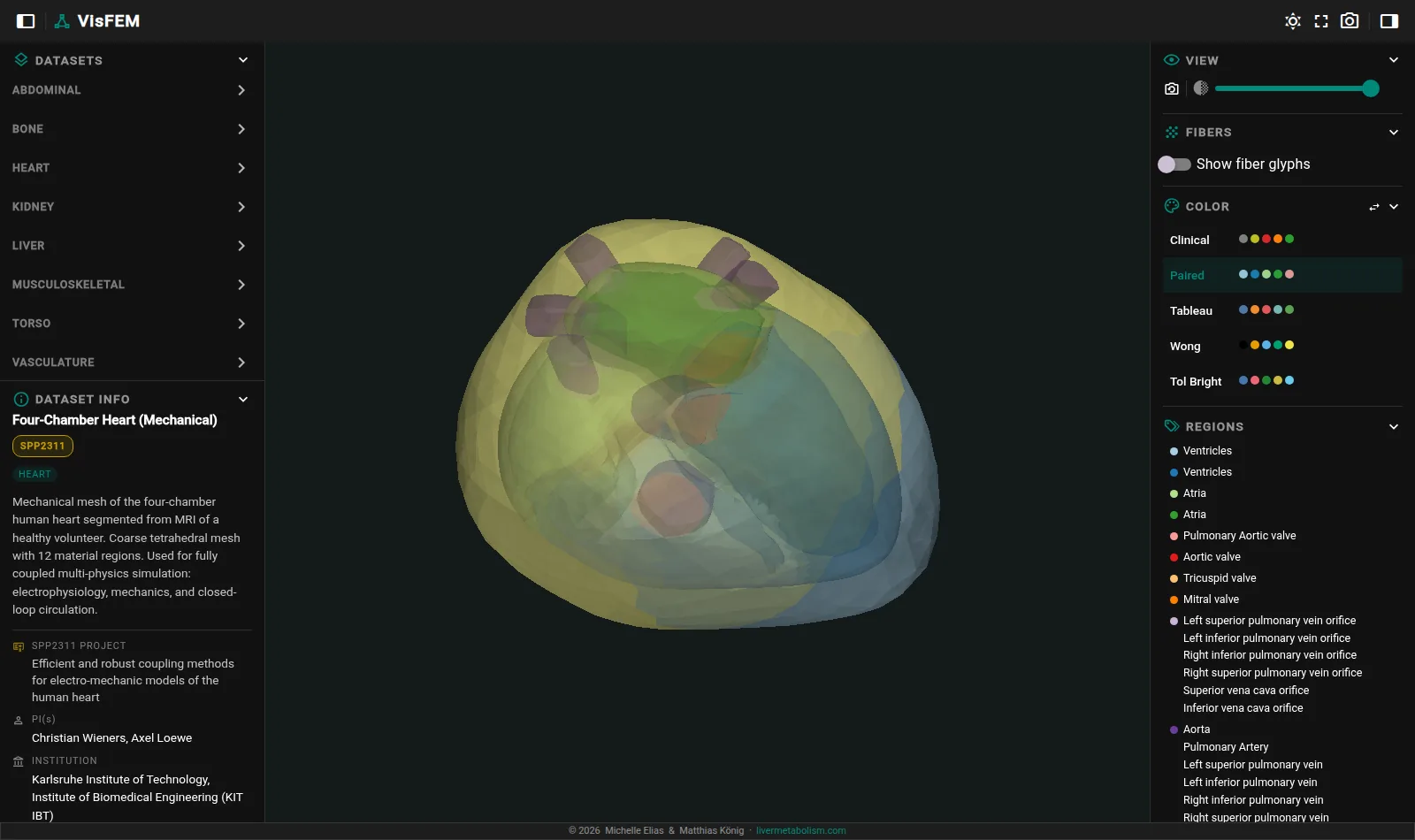
Features
- Datasets - a dataset is a folder of mesh files plus a JSON descriptor with its scientific context: principal investigator, institution, organ system, references. VisFEM discovers every dataset of a data directory and groups them by organ system.
- Renderers - seven built-in renderers cover static surfaces, multi-part geometries, region-coloured meshes with fibre glyphs, scalar fields and time series from XDMF, PVD, VTK series or LS-DYNA d3plot files.
- Mesh formats - everything meshio and PyVista read, e.g., VTK, VTU, STL, OBJ, PLY, XDMF+HDF5, PVD, plus FEBio 2.x models and LS-DYNA d3plot databases.
- Interaction - categorical palettes and continuous colormaps, opacity, region legends, playback of time series, screenshots, a light and a dark theme, and WebXR for viewing a model in virtual reality.
- Command line -
visfemlaunches the app and scaffolds, documents and validates datasets. - Example data -
visfem fetch-ircadbandvisfem fetch-openkneedownload two public datasets ready to view.
Quickstart
The app opens in the browser. Point DATA_DIR at a data directory to view your own datasets, see Running the app.
How to cite
If you use VisFEM, please cite the software repository:
Elias, M. & König, M. (2026). VisFEM: Web visualization of FEM models. Zenodo. https://doi.org/10.5281/zenodo.19220183
The citation information is also available in the CITATION.cff of the repository.
License
- Source code: MIT
- Documentation: CC BY-SA 4.0
The example datasets keep the licenses of their providers, see Example data.
The software ships as is; the MIT license in LICENSE disclaims all warranties, including merchantability and fitness for a particular purpose.
Funding
The German Research Foundation (DFG) supports Matthias König within the Research Unit Programme FOR 5151 "QuaLiPerF (Quantifying Liver Perfusion-Function Relationship in Complex Resection - A Systems Medicine Approach)" by grant number 436883643 and by grant number 465194077 (Priority Programme SPP2311, Subproject SimLivA).
The Federal Ministry of Education and Research (BMBF, Germany) supported Matthias König within the research network Systems Medicine of the Liver (LiSyM, grant number 031L0054).
The German Research Foundation (DFG) supports Michelle Elias under grant number 465194077 (Priority Programme SPP2311).
© 2026 Michelle Elias & Matthias König